

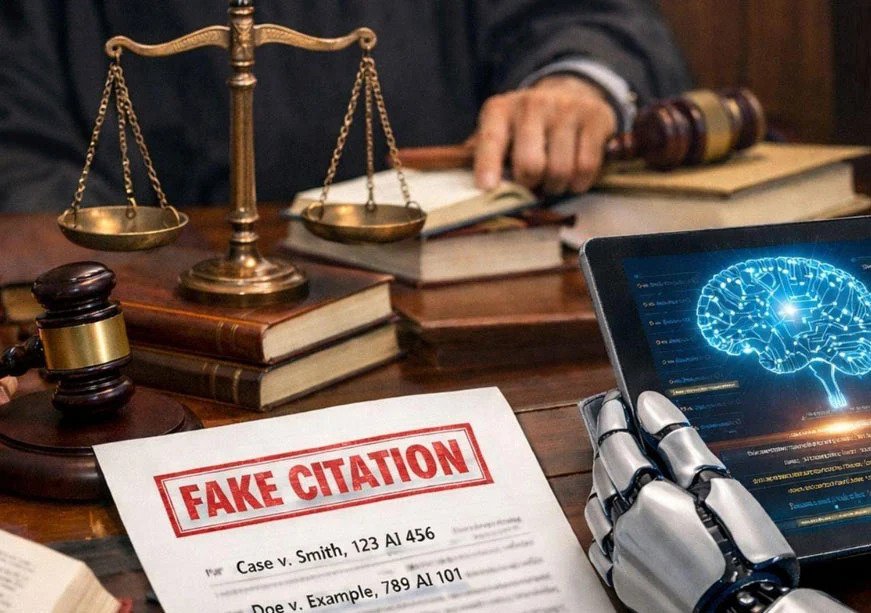
Artificial intelligence (AI) is changing how legal professionals conduct research, analyse documents, prepare submissions, and organise case information. However, its growing use in legal practice has introduced a serious risk: AI systems can generate fictional court judgments, incorrect case citations, and passages that do not appear in the original judicial decisions.
The issue has become particularly significant in India following the Supreme Court’s intervention in cases involving AI-generated fake judicial precedents. The Court has emphasised that legal authorities presented before a court must be authentic and verified. A fabricated judgment cannot become a valid legal precedent simply because it appears convincing or is included in a professionally drafted submission.
In Pooja Ramesh Singh v. Jammu and Kashmir Bank Ltd., decided on 2 July 2026, the Supreme Court of India set aside decisions of the National Company Law Tribunal (NCLT) and the National Company Law Appellate Tribunal (NCLAT) after finding that the adjudicatory process had relied on fake or hallucinated legal material. The Court also directed the Bar Council of India to constitute a committee to address the submission of fabricated precedents and recommend appropriate guidance and disciplinary consequences.
This development raises important questions about the responsibilities of advocates, the accountability of judicial officers, and the proper use of AI in legal proceedings.
What Are AI-Generated Fake Judgments?
AI-generated fake judgments are fabricated or inaccurate representations of judicial decisions produced or reproduced through artificial intelligence tools. These errors are often described as AI hallucinations.
A hallucination occurs when an AI system produces information that appears plausible but is not supported by reliable source material. In legal research, this may involve inventing a case, assigning an incorrect citation to a judgment, attributing fictional paragraphs to a genuine decision, or misrepresenting what a court actually held.
There are several common forms of inaccurate AI-generated legal material:
- Non-existent judgments: The cited case cannot be found in reliable legal records.
- Fabricated citations: A case name, court, date, or citation is incorrect or invented.
- False quotations: A genuine judgment is cited, but the quoted passage does not appear in the original decision.
- Misrepresented legal principles: An actual judgment is described as supporting a proposition that it does not establish.
- Incorrect procedural information: The output inaccurately describes a court order, the status of a proceeding, or the applicable legal rule.
These problems can affect pleadings, written submissions, legal opinions, research memoranda, and judicial orders.
The key distinction is between using AI as a research assistant and presenting unverified AI-generated material as authentic law. The former can support legal work when used responsibly; the latter can undermine the reliability of court proceedings.
The Supreme Court’s Stand on AI-Generated Fake Judgments
The Supreme Court’s approach became particularly clear through two developments in 2026.
The February 2026 proceedings
On 27 February 2026, the Supreme Court expressed concern about a trial court’s reliance on purported judgments that were alleged to be non-existent and AI-generated. The matter arose from civil proceedings involving objections to an advocate commissioner’s report.
The Court observed that reliance on fake judgments could not simply be treated as an ordinary error in decision-making and that legal consequences could follow. It sought responses from senior law officers and the Bar Council of India to examine the issue.
These proceedings highlighted that the risks of AI-generated legal material extend beyond advocates’ written submissions. Courts and tribunals may also encounter fabricated authorities through their own research or other materials placed before them.
The July 2026 judgment
A more definitive ruling followed in Pooja Ramesh Singh v. Jammu and Kashmir Bank Ltd., decided on 2 July 2026.
The dispute arose from insolvency proceedings under Section 7 of the Insolvency and Bankruptcy Code, 2016. The NCLT, Mumbai, had admitted an insolvency application against Essel Infraprojects Ltd. The NCLAT subsequently upheld the decision.
Before the Supreme Court, the appellant challenged the reliance on six purported judicial authorities. The Supreme Court’s examination found that the cited material included non-existent judgments and passages incorrectly attributed to genuine cases.
Importantly, the respondent bank filed an affidavit stating that the disputed judgments had not been cited by its counsel at the hearing. The Supreme Court noted that the NCLT appeared to have obtained the material through its own research, and that the errors had also escaped scrutiny at the appellate tribunal stage.
The Court set aside the NCLT and NCLAT decisions and restored the insolvency application for fresh disposal on its merits.
The ruling establishes an important principle: judicial decision-making must be based on authentic legal authorities, and fabricated precedents cannot be permitted to compromise the integrity of adjudication.
Legal Consequences for Lawyers Using AI-Generated Fake Judgments
The consequences for advocates depend on the circumstances, the nature of the conduct, the applicable professional rules, and any disciplinary determination. The Supreme Court’s 2026 ruling nevertheless makes the duty to verify cited authorities particularly clear.
1. Professional misconduct concerns
An advocate’s responsibility does not end with preparing a persuasive legal argument. Citations and quotations submitted to a court must accurately represent the law.
In its July 2026 judgment, the Supreme Court declared that citing AI-generated fake or hallucinated judgments without verification constitutes professional misconduct. It also directed the Bar Council of India to constitute a committee to consider guiding principles and disciplinary consequences.
This does not mean that every mistake involving AI automatically results in the same punishment. The nature of the error, the advocate’s conduct, the applicable professional framework, and the findings of the competent authority remain relevant.
However, knowingly or carelessly presenting fabricated authorities as genuine law can raise serious professional concerns.
2. Disciplinary proceedings
The Bar Council of India and the relevant disciplinary framework have an important role in addressing professional misconduct by advocates.
The Supreme Court’s direction for a committee reflects the need to develop appropriate guidance on the submission of fabricated or hallucinated legal material.
Potential disciplinary consequences must be assessed under the applicable rules and procedures. The July judgment directed the development of guidance and disciplinary principles; it should not be interpreted as prescribing one automatic penalty for every instance of AI-related error.
Advocates should therefore treat verification as a professional obligation rather than an optional quality-control measure.
3. Damage to professional credibility
Submitting a fabricated judgment can damage an advocate’s credibility before a court. Judges rely on the accuracy of legal authorities when assessing arguments, and incorrect citations can divert attention from the actual issues in dispute.
The consequences may extend beyond a single hearing. An error may require additional submissions, explanations, corrected filings, or further proceedings. Depending on the circumstances, it can also raise questions about the reliability of other material prepared for the case.
Maintaining accurate citations and transparent research practices is therefore essential to effective advocacy.
4. Possible costs or other court orders
Courts may have powers under applicable law and procedure to address defective or improper filings. Whether costs, sanctions, disciplinary action, or another consequence is appropriate depends on the facts, jurisdiction, and legal basis for the action.
The Supreme Court’s ruling should not be read as creating a universal fixed fine for every AI-generated citation error. Its central concern is that fabricated legal authorities must not enter the adjudicatory process as though they were genuine precedents.
Legal Consequences for Courts and Judges
The responsibility to verify legal material also applies to the judicial process.
1. Judicial responsibility to examine cited authorities
Judges and tribunals routinely depend on submissions from advocates, but the existence of a citation does not establish its authenticity or relevance.
In its July 2026 judgment, the Supreme Court described reliance on fake or hallucinated AI-generated precedents by a judge as a serious lapse. The decision underlined that the integrity of adjudication requires authentic sources and independent judicial assessment.
This principle is especially important when AI tools are used for legal research, summarisation, or preparation of draft orders.
2. Decisions based on fabricated precedents may be set aside
The Supreme Court held that a decision tainted by fake or hallucinated material cannot stand in law. It adopted a zero-tolerance approach to the unverified use of such material in judicial decision-making.
In the Pooja Ramesh Singh case, the Court set aside the NCLT and NCLAT decisions and directed fresh consideration of the insolvency application.
This was a case-specific judicial remedy. It does not mean that every decision involving any AI-assisted research is automatically invalid. The critical issue is the introduction and reliance on fake or hallucinated material as judicial precedent.
3. Appellate scrutiny and institutional safeguards
The case also drew attention to the fact that the fabricated authorities had escaped detection at the first appellate stage.
Appellate review, source verification, and appropriate judicial safeguards are important for preventing inaccurate legal material from influencing decisions. Courts must retain control over their reasoning and cannot substitute unverified AI output for independent legal analysis.
The Supreme Court has also emphasised the importance of human oversight in the use of AI in adjudication.
How Lawyers Can Verify AI-Generated Legal Citations
A practical verification process can reduce the risk of relying on fabricated legal authorities.
Step 1: Locate the original judgment
Search for the case in official court records or a reliable legal database. Confirm that the judgment exists and that the citation corresponds to the correct decision.
For Supreme Court matters, advocates can consult the official Supreme Court of India website. Other courts and tribunals may provide their own judgment repositories.
Step 2: Verify the quoted passage
Do not rely only on an AI-generated summary. Open the complete judgment and locate the paragraph or passage being cited.
Check whether the text is reproduced accurately and whether the surrounding context supports the proposition for which it is being used.
Step 3: Confirm the legal principle
A judgment may exist without supporting the argument attributed to it. Read the relevant reasoning and determine whether the case actually establishes the claimed legal principle.
Distinguish the court’s binding holding from background observations, submissions made by parties, and statements that may not be central to the decision.
Step 4: Check subsequent judicial treatment
Where relevant, examine whether the decision has been overruled, distinguished, modified, or otherwise affected by later judgments. Confirm that the authority remains applicable to the legal issue being argued.
Step 5: Conduct a final review before filing
The advocate responsible for the submission should review every material citation and quotation. Verification should take place before the document is finalised, not only after a court questions its authenticity.
A documented review process can help legal teams identify errors before they enter the judicial record.
Can Lawyers Still Use AI for Legal Research?
Yes. The Supreme Court’s ruling does not prohibit the legitimate use of artificial intelligence in legal work.
AI can assist with organising case documents, identifying research questions, summarising lengthy materials, developing preliminary arguments, and preparing working drafts. These tasks can be useful when the output is checked against reliable sources and reviewed by a qualified professional.
The difficulty arises when AI output is treated as authoritative without verification. An AI-generated citation is a research lead, not proof that a judgment exists or supports a legal proposition.
Law firms and legal departments can reduce risk by establishing clear internal procedures, training staff on AI limitations, protecting confidential client information, and requiring human review before legal documents are filed.
Technology should support professional judgment, not replace it.
Frequently Asked Questions
Is it illegal for lawyers to use AI in India?
The Supreme Court’s July 2026 ruling does not prohibit all AI use in legal practice. It specifically emphasises that producing, citing, or relying on AI-generated fake precedents without verification is unacceptable. The legality and professional implications of a particular use depend on the circumstances and applicable rules.
Can a lawyer face disciplinary action for citing a fake judgment?
Yes, citing an AI-generated fake judgment without verification can amount to professional misconduct under the principle stated by the Supreme Court. The appropriate disciplinary consequences depend on the applicable framework and the facts of the case.
Can a court order be set aside because it relies on a fake AI-generated judgment?
The Supreme Court set aside the NCLT and NCLAT decisions in Pooja Ramesh Singh after finding that the adjudicatory process relied on fake or hallucinated precedents. Whether another decision should be set aside depends on the relevant facts, procedural position, and applicable law.
Does the Supreme Court allow AI in judicial proceedings?
The Court has clarified that its concern is not legitimate AI use but the presentation or reliance on fabricated material as genuine precedent. Human oversight and independent verification remain essential.
How can an advocate avoid AI hallucinations in legal research?
An advocate should locate the original judgment, verify the citation and quoted paragraphs, examine the legal principle in context, check subsequent judicial treatment where relevant, and review every material authority before filing.
Conclusion
The Supreme Court’s decisions on AI-generated fake judgments highlight a fundamental principle of legal practice: technology cannot replace the duty to verify the law.
For advocates, fabricated citations can raise professional misconduct concerns and undermine credibility. For courts and tribunals, reliance on non-existent precedents can compromise the integrity of adjudication and result in decisions being set aside.
The practical response is not to reject AI entirely but to use it responsibly. Legal professionals should verify original judgments, check quotations, assess the relevance of precedents, and maintain human oversight throughout the research and drafting process.
As AI becomes more common in legal practice, accurate research and professional accountability remain essential to protecting the rule of law and public confidence in the judicial system.